
How to List Languages on a Resume (With CEFR Levels)
How to list languages on a resume: CEFR levels A1 to C2 explained, how to show IELTS, TOEFL, Cambridge, DELF or Goethe results, wording examples and placement.

Resumeza Team
The team behind Resumeza

On this page
Build a resume that gets interviews
- ATS-optimized templates
- AI-powered writing
- Free to start
No credit card required
"Spanish: fluent." That's how most people list languages on a resume, and it leaves the reader guessing. Fluent for ordering dinner, or fluent for negotiating a supplier contract? The recruiter can't tell, and neither can the hiring manager in another country who learned a different meaning of "fluent" at school.
To list languages on a resume, give each language a level the reader can check: a CEFR level (A1 to C2), backed by a certificate and score if you have one. Put them in a short Languages section near the end of the resume, unless the job requires the language. Then it also belongs in your headline or summary, where the recruiter looks first.
TL;DR: Write "Language: CEFR level (certificate, score, year)", for example "German: C1 (Goethe-Zertifikat C1, 2025)". Use "Native" for your first language. Order by relevance to the job. Skip skill bars and percentages. If the job ad names a language requirement, mirror its wording and move the language up the page.
How to List Languages on a Resume: The Format
A language line has up to four parts. Use as many as you can back up:
- The language, in English: "German", not "Deutsch".
- A level, ideally on the CEFR scale: "C1".
- Proof, if you have it: the certificate name and score.
- The year of the certificate, so the reader knows how current it is.
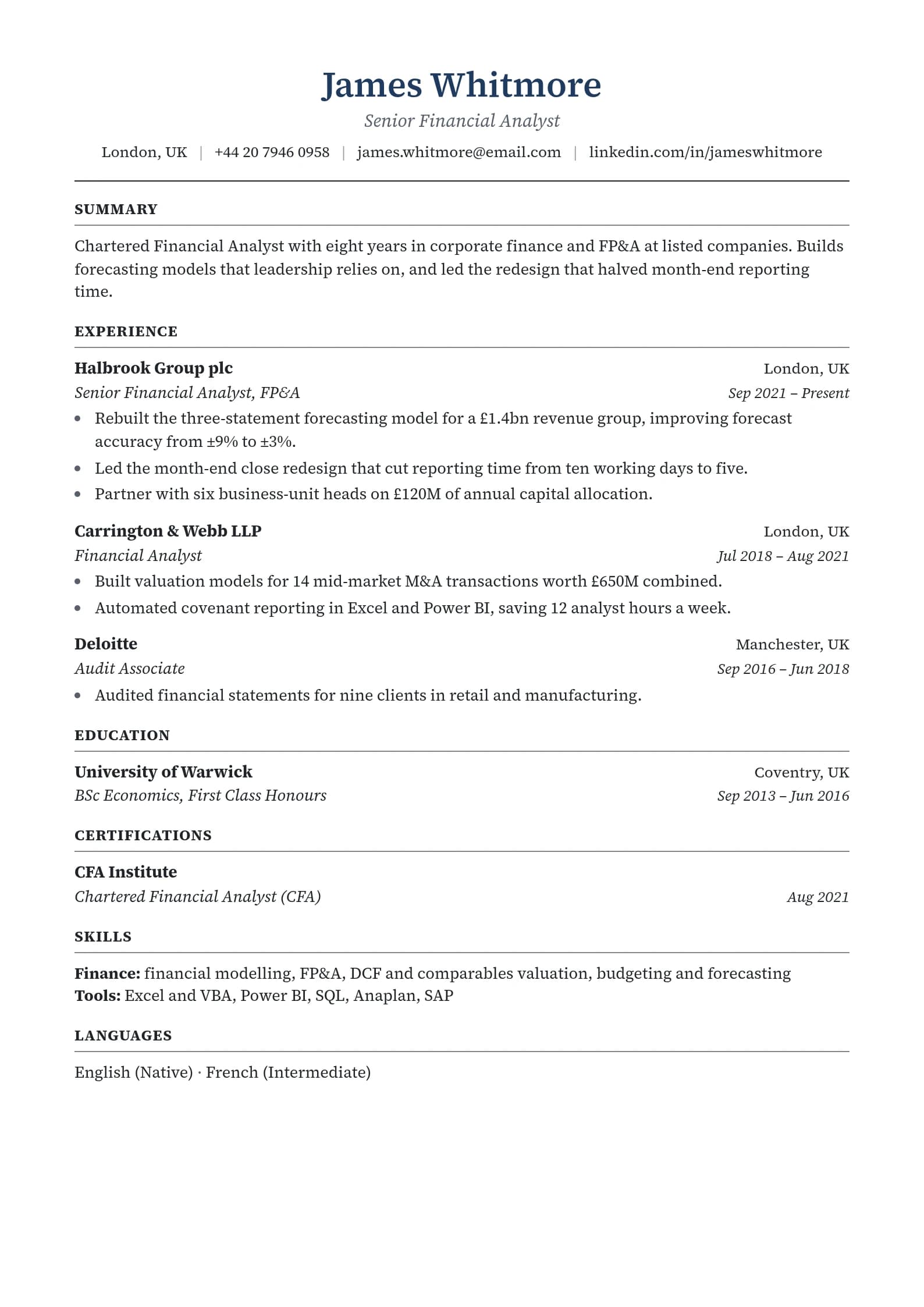
Languages English: Native Spanish: C1 (DELE C1, 2024) French: B2, used daily with clients in Belgium Mandarin Chinese: A2
The third line shows the alternative to a certificate: evidence of use. If you never sat a test but spent three years handling French-speaking accounts, say so. That's more convincing than a self-assessed level on its own.
CEFR Language Levels Explained (A1 to C2)
The Common European Framework of Reference for Languages (CEFR) is a six-level scale published by the Council of Europe that describes what a language user can do at each stage. It's used well beyond Europe, and several major English tests now report results against it, so it's the safest scale to put on an international resume.
The table below summarizes the Council of Europe's global scale in plain terms, with resume wording that matches each level.
| Level | Council of Europe group | What a user at this level can do (summary) | Fits on a resume as |
|---|---|---|---|
| C2 | Proficient user | Understands virtually everything heard or read, and expresses fine shades of meaning precisely, even in complex situations | C2, near-native |
| C1 | Proficient user | Understands demanding, longer texts; speaks fluently and spontaneously; uses the language flexibly for social, academic and professional purposes | C1, professional working level |
| B2 | Independent user | Understands complex texts, including technical discussion in their own field; interacts with native speakers without strain on either side | B2, upper intermediate |
| B1 | Independent user | Handles familiar matters at work, school or while traveling; writes simple connected text and explains opinions briefly | B1, intermediate |
| A2 | Basic user | Understands frequent expressions on everyday topics and handles simple, routine exchanges | A2, elementary |
| A1 | Basic user | Uses familiar everyday expressions and basic phrases, if the other person speaks slowly and helps | A1, beginner |
Two practical notes:
- "Native" isn't a CEFR level. Write "Native" for your first language, and "Native (bilingual)" if you grew up with two.
- Be honest about the gap between levels. Most office jobs that "require" a language mean B2 or above. If you're B1, say B1. An interviewer who switches languages halfway through the call will find out in a minute.
Other Language Scales: ILR and ACTFL
Two other scales come up mostly in the United States. Use them only if the employer does, or if you hold an official rating on that scale. Otherwise, use CEFR.
| Scale | Who uses it | Levels |
|---|---|---|
| ILR (Interagency Language Roundtable) | US government agencies | 0 No Proficiency, 1 Elementary, 2 Limited Working, 3 General Professional, 4 Advanced Professional, 5 Functionally Native, with "plus" levels between them |
| ACTFL (American Council on the Teaching of Foreign Languages) | US language teaching and testing | Novice, Intermediate, Advanced, Superior, Distinguished; the first three split into Low, Mid and High |
An ILR rating on a resume looks like "Arabic: ILR 3 (General Professional Proficiency)". If you're applying for a US federal job, check the announcement for which scale it uses.
Language Certificates on a Resume
A certificate turns a claim into a fact. If you have one, put the certificate's name, your result and the year in brackets after the level. This table covers the certificates recruiters see most often.
| Certificate | Language | How results are reported | Does it expire? |
|---|---|---|---|
| IELTS | English | Band scores on a 9-band scale, in whole and half bands | IELTS recommends treating results as valid for two years; organizations may accept older ones |
| TOEFL iBT | English | Since 21 January 2026, a 1 to 6 scale in half points aligned to CEFR; for two years, reports also show a comparable 0 to 120 score | Valid for two years from the test date |
| Cambridge English (B2 First, C1 Advanced, C2 Proficiency) | English | A certificate at a CEFR level, with a Cambridge English Scale score | Valid indefinitely; each employer or university decides how recent it must be |
| DELF and DALF | French | Separate diplomas: DELF for A1 to B2, DALF for C1 and C2 | Valid for life |
| Goethe-Zertifikat | German | Exams for each level, A1 to C2 | Valid indefinitely, though some authorities and employers ask for a recent one |
| DELE | Spanish | Diplomas for each level, A1 to C2 | No expiry date |
How they look on a resume:
- English: C1 (IELTS Academic 7.5, 2025)
- English: C1 (TOEFL iBT 5.0, 2026)
- English: C2 (Cambridge C2 Proficiency, 2021)
- French: B2 (DELF B2, 2023)
- German: B1 (Goethe-Zertifikat B1, 2024)
What if your IELTS or TOEFL result is more than two years old? List it with the year anyway; the date tells the reader exactly what it is. If the job or a visa application needs a valid score, you'll have to retake the test, but that's a question for later in the process, not a reason to leave the line off your resume.
Where Does the Languages Section Go on a Resume?
By default, near the end, after skills and education. It moves up when the language is part of the job. Use this checklist:
- The ad requires the language ("fluent German required", "bilingual Spanish and English agent"). Put it in your headline or the first line of your summary, list it in your skills section, and keep the full line with the certificate in the Languages section. Example headline: "Bilingual Customer Support Specialist (English, Spanish C1)".
- The language is a plus, or useful for the location. Keep it in the Languages section.
- Your level is A1 or A2. Include it only if it's relevant to the job or the country you're moving to. Otherwise it takes space without helping.
- You list several languages. Order them by relevance to this job, not by level. A C1 in the client's language beats a native language the role never uses.
Avoid skill bars, stars and percentages. "German 70%" doesn't mean anything a reader can check, and applicant tracking systems can't read bars or icons at all. A CEFR level in plain text works for both readers.
Applying in Germany? Our sister site Lebenslauf AI (in German) explains how to present Sprachkenntnisse, language skills, in a German-style Lebenslauf, where employers expect the same CEFR levels.
Before and After: Language Lines That Work
| Before | Problem | After |
|---|---|---|
| Spanish: fluent | Self-assessed, means different things to different readers | Spanish: C1 (DELE C1, 2024) |
| English: good | Vague | English: B2, written client reports weekly |
| Mother tongue: Polish | Fine, but wordier than it needs to be | Polish: Native |
| German ★★★☆☆ | Stars aren't a level, and parsers skip them | German: B1 (Goethe-Zertifikat B1, 2024) |
| Bilingual English/Arabic | Doesn't say which is stronger, if either | Arabic: Native; English: C2 (Cambridge C2 Proficiency) |
| French: basic, Italian: basic, Russian: basic | Three A-level languages that don't relate to the job | Cut them, or keep only the one the job uses |
If English is the language you're working on, our guide to writing a resume in English as a non-native speaker covers the grammar, spelling and translation side. And if a language is part of why you're moving abroad, see how to say you're willing to relocate on a resume.
Add your languages with a level
The Languages section in the Resumeza resume builder gives each language a level (Basic, Intermediate, Fluent or Native), and the language name field takes extra detail, so you can write "Spanish, C1, DELE 2024" and still pick a level. A sensible match is Basic for A1 and A2, Intermediate for B1 and B2, Fluent for C1 and C2. Building is free, and your first PDF or Word download is free.
Frequently Asked Questions
How do I describe my language level on a resume?
Use a CEFR level from A1 (beginner) to C2 (near-native), and add a certificate and score if you have one, for example 'German: C1 (Goethe-Zertifikat C1, 2025)'. Write 'Native' for your first language. If you have no certificate, add a short line of evidence, such as 'used daily with clients in Belgium'.
Is B2 considered fluent?
B2 is an upper intermediate level. A B2 user can follow complex texts in their own field and talk with native speakers without strain, which is enough for many office jobs. 'Fluent' is usually understood as C1 or above, so write the CEFR level rather than the word fluent.
Should I put languages on my resume if I'm a beginner?
Only if the language is relevant to the job or to the country you're applying in. An A1 or A2 level can show effort when you're moving to that country, but for an unrelated job it takes space without helping.
Where should languages go on a resume?
In a Languages section near the end, after skills and education. If the job requires a language, also mention it in your headline or summary and in your skills section, so the recruiter sees it in the first few seconds.
Resumeza Team
The team behind Resumeza
The team that builds Resumeza's resume templates and ATS checker and writes its expert reviews..
Your resume is your first impression. Make it count.
Build an ATS-optimized resume that gets read, with AI help on every section.
No credit card required. Your first PDF or Word download is free; after that, Pro is $6.95 a month.
Continue Reading
View all articles
How to Write a Resume in English as a Non-Native Speaker

Willing to Relocate? How to Say It on Your Resume

Customer Service Resume: Skills, Metrics and Bullets

How to Write a Project Manager Resume That Shows Results

How to Follow Up After Applying for a Job

Career Change Resume Summary: What to Write (Examples)
Build a resume that gets interviews
Ready to build your resume?