
Career Change Resume Summary: What to Write (Examples)
How to write a resume summary when you're changing careers: the target, proof, bridge formula, six examples for common career moves, and the mistakes that sink career changers.

Resumeza Team
The team behind Resumeza

On this page
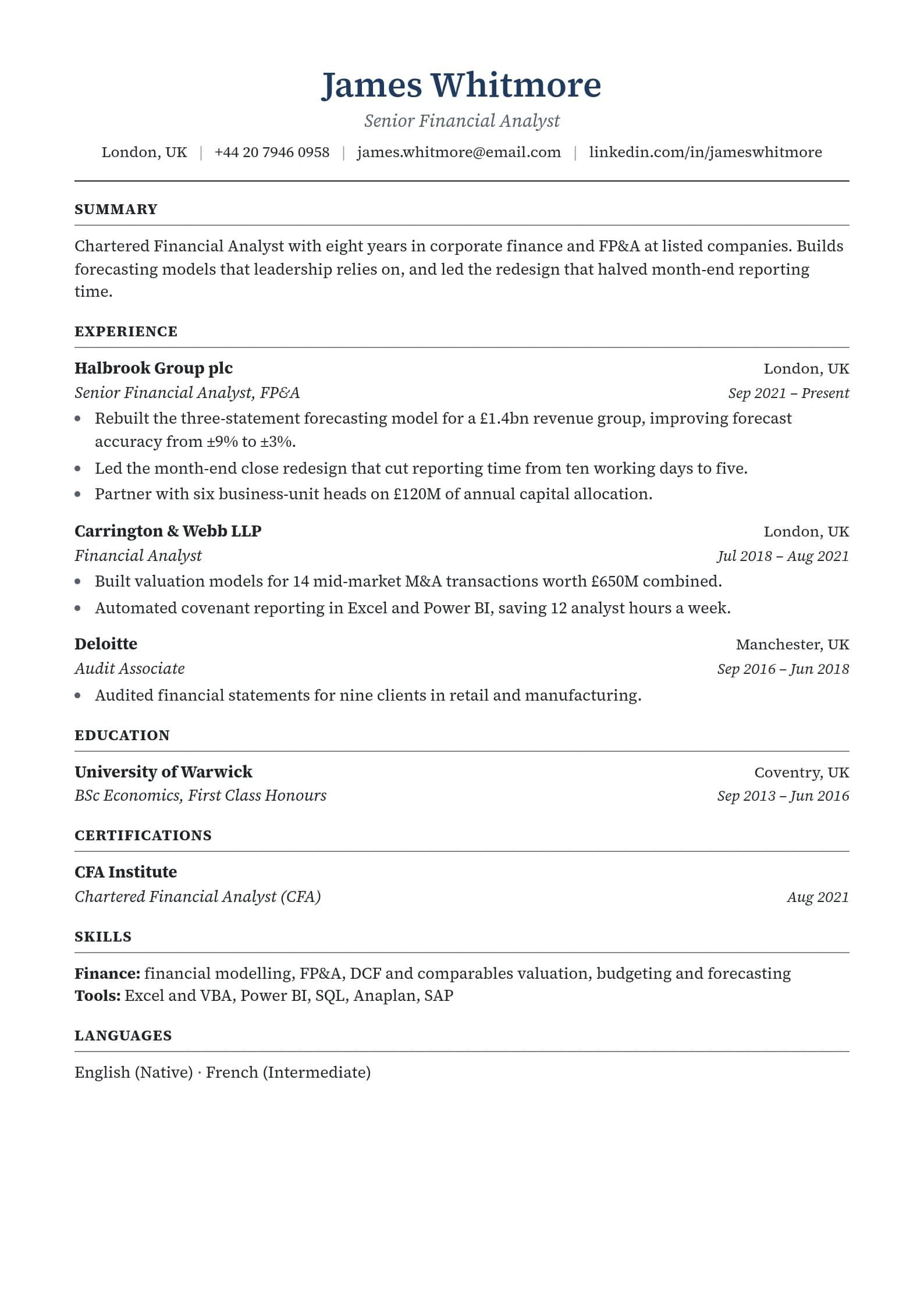
Build a resume that gets interviews
- ATS-optimized templates
- AI-powered writing
- Free to start
No credit card required
You've decided. After years as a teacher, or a store manager, or a journalist, you want something different. You've taken the course, you've done the reading, maybe you've even done some freelance work on the side. Then you open your resume and the top of it still says "Experienced high school English teacher".
That top section is the problem. A recruiter skimming applications for an instructional design role reads "teacher", decides you're applying for the wrong job, and moves on before reaching the part of your resume that proves you can do it. When you're changing careers, your summary has a job no other part of your resume can do: it tells the reader how to read everything below it.
TL;DR: Use the Target, Proof, Bridge formula. Sentence 1 names the role you want (the target). Sentence 2 gives one or two results from your current career that matter in the new one (the proof). Sentence 3 shows what you've done to cross over: a course, a project, freelance work, a certification (the bridge). Put a matching headline above it.
Why Career Changers Need a Summary More Than Anyone
A resume summary is a three to four sentence paragraph at the top of your resume that states who you are professionally, your strongest evidence and the role you're targeting.
For most job seekers, it's helpful. For career changers, it's essential, because everything else on the page points backwards. Your job titles, employers and most of your bullets describe your old career. Without a summary, the reader has to work out for themselves why a former chef is applying to be a quality assurance coordinator. Most won't.
The summary is where the parser, the recruiter and the hiring manager all get their first impression, as we explain in how to write a resume that passes ATS and gets read. For a career changer, it's the bridge between two careers.
The Target, Proof, Bridge Formula
| Part | What it does | Sentence pattern |
|---|---|---|
| Target | Names the new role, so the reader knows what lens to use | "[New role or field] professional with [X years] of [transferable skill area] experience..." |
| Proof | Shows one or two results from your old career that matter in the new one | "In [old role], [achievement] by [method]." |
| Bridge | Shows the concrete steps you've taken into the new field | "Recently completed [course or certification] and [project or freelance work]." |
Optional fourth sentence: what you're looking for, if it adds clarity ("Seeking a junior UX research role in a product team").
Add a target headline
Directly above the summary, put a one-line headline with the job title you're applying for, not the one you hold:
Instructional Designer | Learning Experience Design, Articulate 360, Adult Learning
The headline tells the skimmer and the search tools what you're applying as. The summary justifies it.
Six Career Change Summary Examples
Teacher to instructional designer
Instructional Designer | E-learning, Articulate Storyline, Curriculum Design
Instructional designer with eight years of experience designing curriculum and assessments for 150+ learners a year. As a high school English teacher, redesigned my department's essay-writing unit into a blended online course that other teachers in the district adopted. Recently completed a certificate in instructional design and built three e-learning modules in Articulate Storyline for a nonprofit client.
Retail store manager to operations coordinator
Operations Coordinator | Inventory Control, Scheduling, Vendor Management
Operations professional with six years running multi-department retail stores, including staffing, inventory and supplier deliveries. As store manager, cut stock discrepancies by a third by introducing weekly cycle counts and retrained a 22-person team on receiving procedures. Completed an online course in supply chain fundamentals and now looking to move into a distribution or logistics operations role.
Journalist to content marketer
Content Marketing Manager | Editorial Strategy, SEO Writing, Audience Research
Content strategist with nine years of experience as a reporter and section editor, publishing on deadline for a regional news site. Grew the business section's newsletter from 2,000 to 9,000 subscribers by testing subject lines and send times. Over the past year, wrote SEO-focused articles and case studies for three B2B software companies as a freelancer.
Accountant to data analyst
Data Analyst | SQL, Python, Power BI, Financial Analysis
Analyst with five years of experience in financial reporting and variance analysis for a mid-sized manufacturer. Built the finance team's first Power BI dashboard, replacing a manual 20-tab spreadsheet used in monthly reviews. Completed a data analytics certificate and published two portfolio projects analyzing public datasets with SQL and Python.
Hospitality supervisor to customer success
Customer Success Associate | Client Retention, Onboarding, Issue Resolution
Customer-focused professional with seven years in hotel guest services, most recently supervising a front desk team of 10. Raised the property's guest satisfaction scores for check-in over two consecutive years by redesigning the arrival process. Completed a customer success fundamentals course and learned HubSpot and Zendesk through volunteer work for a local startup.
Nurse to clinical informatics
Clinical Informatics Specialist | EHR Optimization, Workflow Design, Staff Training
Registered nurse with ten years of acute care experience, including four as the ward's electronic health record super-user. Led training for 60 nurses during the hospital's EHR upgrade and documented workflow fixes that the IT team adopted. Currently completing a postgraduate certificate in health informatics.
All examples are illustrations. Your numbers, tools and courses should be your own.
How to Find Your Proof
The proof sentence is the hardest to write, because you have to look at your old career through the new employer's eyes. Try this:
- Read three job ads for your target role and list the skills and responsibilities that come up repeatedly.
- Highlight anything you've already done, even under a different name. A teacher "designs curriculum", an instructional designer "designs learning experiences". Same work, different vocabulary.
- Pick the result that best matches the ad's first must-have. That's your proof sentence.
- Translate the language. Use the target field's terms where they honestly describe your work.
If your old bullets are mostly duties, rewrite them first using the four-rung ladder in our achievement bullets guide. Strong proof comes from strong bullets.
Career Change Summary Mistakes
| Mistake | Example | Fix |
|---|---|---|
| Leading with the old title | "Experienced sales manager seeking a change" | Lead with the target role |
| Apologizing | "Although I have no direct experience in UX..." | State what you do have |
| Listing soft skills | "Passionate, adaptable, fast learner" | Show one result that proves them |
| Focusing on what you want | "Looking for a role where I can grow" | Focus on what you offer |
| No bridge | Old career only, nothing about the new field | Name a course, project, certification or freelance work |
| Too long | A seven-line paragraph | Three or four sentences |
| Generic across applications | The same summary for every ad | Adjust the target and proof for each role type |
That last one matters. If you're applying to two kinds of role, keep two versions of your summary. Our guide on tailoring one resume to many job ads shows how to manage versions without rewriting everything.
What Goes Below the Summary
The summary sets up the reader; the rest of the resume needs to back it up:
- A short "Relevant experience" or "Selected projects" section above your work history can show bridge work early: freelance projects, portfolio pieces, volunteer work in the new field.
- Your work history stays in reverse-chronological order, with bullets rewritten to emphasize transferable results.
- Education and certifications that support the switch can move higher than usual.
- Keep it to one or two pages. Career changers sometimes over-explain. See resume length by career stage.
Write your bridge summary
The Resumeza resume builder helps you draft a summary for the role you want, not the one you're leaving, and lets you keep a version for each type of role. Building is free, and your first PDF or Word download is free.
Frequently Asked Questions
What should a career change resume summary include?
Three parts: the target role you're applying for, one or two results from your current career that matter in the new one, and the steps you've taken to move across, such as a course, certification, project or freelance work. Keep it to three or four sentences and add a headline with the target job title above it.
Should I use a resume objective or a summary when changing careers?
Use a summary. A traditional objective only says what you want, while a summary shows what you offer and why it transfers. You can include one short line about the role you're seeking at the end of the summary.
Should I mention that I'm changing careers on my resume?
You don't need to announce it. Lead with the target role in your headline and summary, then show transferable proof and bridge work. The reader will understand the move without an explanation or an apology.
How long should a career change resume summary be?
Three or four sentences, roughly 50 to 80 words. Long enough to state the target, the proof and the bridge, short enough to read in a quick skim.
Resumeza Team
The team behind Resumeza
The team that builds Resumeza's resume templates and ATS checker and writes its expert reviews..
Your resume is your first impression. Make it count.
Build an ATS-optimized resume that gets read, with AI help on every section.
No credit card required. Your first PDF or Word download is free; after that, Pro is $6.95 a month.
Continue Reading
View all articles


Build a resume that gets interviews
Ready to build your resume?